I proudly served more than 12 years in local government, more than seven as mayor of the City of South Milwaukee. Let me put the lessons I learned to work for you.
Bringing a “Fresh Set of Eyes” – and Strategy – to a Referendum Communications Campaign

Challenge
South Milwaukee – facing a critical funding shortfall for its paramedic program and a need to add more police officers – chose to hold a public safety referendum in 2017, asking voters to consider a more than 6% property tax increase to cover the added expenses. The issue was complex, and voters lacked knowledge about the budget realities that led to the referendum – and what a “yes” or “no” vote would mean to delivery of those services.
Insights
Transparency is critical in government communications, which must also be clear and simple in explaining complex topics to constituents. In educating voters about a referendum, consistency is also key, as is having a campaign mindset – strategically delivering the right message to the right audience at the right time, using the right platform.
Solution
The right third party consultant can real value in this process, offering a “fresh set of eyes” – a strategic education communications plan, independent insights, breakthrough messaging, and creative tactics around how to best engage the public.
Results
South Milwaukee’s referendum passed 2-to-1, and our approach became a model for other municipalities in the state.
_________
Building Bridges: Governments Partnering to Tell Their Community’s Unified Story

Challenge
With the decline of local media – and third-party social media too often telling an inaccurate or slanted story, if it told any story at all – the City of South Milwaukee and South Milwaukee School District were both looking for ways to affordably deliver clear, consistent and compelling content across the community, in a professionally designed platform.
Insights
Working across governments, you can tell a more complete story of your community and amplify your message. In doing so, engage the entire community, not just those online.
Solution
Recognizing they share a common story and common challenges in telling it, the city and school district partnered to launch “Bridges,” an innovative, joint, biannual magazine printed and mailed to each South Milwaukee household. Through feature stories, images and other content, the publication takes a deeper dive into the people, places, programs and events that make South Milwaukee special. Content is planned and authored by the city and school district and professionally edited, designed and mailed by a third party, who also sells ads to keep costs low.
Results
The newsletter has been well-received and immediately showed its importance in delivering critical information on COVID-19 and the school district’s 2024 operating referendum. It also received an Award of Merit from the Wisconsin School Public Relations Association.
_________
Stepping up to Close the Information Void

Challenge
The decline of local media has impacted communities across the region, state and country for decades, making it harder than ever for people to understand what is happening in their neighborhoods. The same was true in South Milwaukee. With fewer journalists and outlets interested in or financially capable of covering the city, there was a huge vacuum for news and information for residents, business owners, visitors and other stakeholders.
Insights
Community leaders have a responsibility to help fill the void left by the demise of local media. Sometimes that is through official government channels. And sometimes you just have to do the work yourself.
Solution
Building on my decade-plus as a journalist, in 2009 I launched South Milwaukee Blog, an online platform sharing news and information — and a little commentary from my roles as alderman and later mayor — about government, crime, fire, schools, sports, community events, and more. In addition to original content, the site aggregates third-party content about South Milwaukee, providing a free “one-stop shop” for information.
Results
Today, South Milwaukee Blog is nearing 2 million page views and 1,000 subscribers, behind thousands of posts, and has become a trusted and valued news source for a city of more than 20,000 people.
_________
Using Facebook to Lift up Local Businesses

Challenge
South Milwaukee’s economic development success story has been rooted in small, independent businesses, with dozens calling the city home and many new ones expanding into the city in the last decade. Many of these businesses struggle to promote themselves, often due to lack of resources, lack of time or lack of knowledge.
Insights
Governments can and should play a role in introducing and promoting their community’s restaurants, goods and services – and sometimes simple solutions can go a long way to do that.
Solution
As mayor, I turned to Facebook for an easy, affordable (free) solution, and “Shop Local South Milwaukee” was born. The unofficial page solely exists to follow other South Milwaukee business pages and share their posts, creating a community of local businesses and giving residents and others a single source for information on products, services, events and more.
Results
The Facebook page now has more than 1,000 followers and is managed by an engaged citizen who posts multiple times a day, driving engagement and interest in the city’s locally owned firms.
_________
Built Tuff: Leaning Into a Viral Bulldog Ice Rescue

Challenge
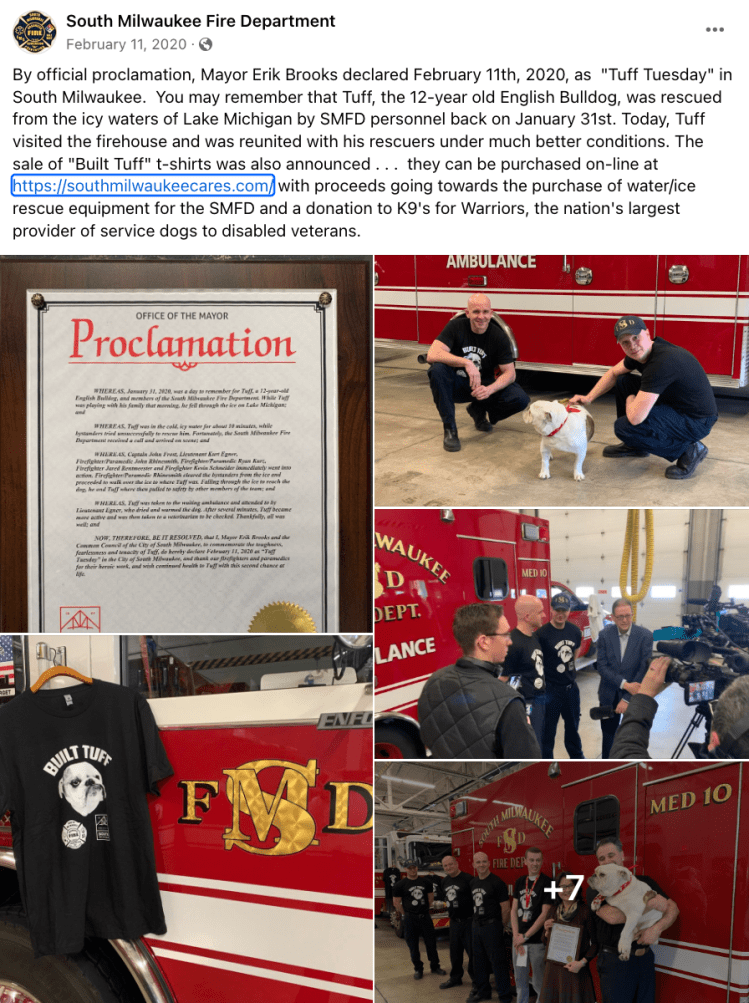
Tuff the Bulldog almost died in 2019, as he ventured too far out onto to the ice of Oak Creek, only to be rescued by the South Milwaukee Fire Department. The incident, caught on camerea, went viral, thanks in part to a fire department Facebook post showing the blanketed bulldog in the back of an ambulance. But that raised a question: Is there any way we can make this more than a one-day news story and social post, while having some fun, and helping others, along the way?
Insights
Recognize viral content when it’s happening – and do not be afraid to seize on it as an opportunity to lift up your government, business or organization. Have fun with it! And look for opportunities to continue to tell the story once the viral moment has passed.
Solution
The city embraced the viral opportunity, from welcoming media to the firehouse to interview the rescuers and meet the human owner of Tuff, to declaring February 11, 2020, “Tuff Tuesday in South Milwaukee.” We also embraced an idea to extend the viral event, for charity. Working with a local apparel company and shipping business, the SMFD and mayor’s office unveiled a line of “Built Tuff” t-shirts and sold them online to raise money for K9s for Warriors, a charity that provides service dogs to disabled military veterans.
Results
The SMFD’s first Tuff rescue post on Facebook attracted more than 4,600 likes or loves and 768 comments, and it was shared more than 1,800 times. Other social posts were dozens of times each. Every local TV station covered the story, and we raised more than $2,400 through the t-shirt sales, keeping this fun story alive for weeks and using it to help others.
_________
Taking a Deep Dive Into Local Tourism
Challenge
The City of Franklin’s Tourism Commission is charged with spending hundreds of thousands of dollars in hotel room tax collections on local tourism efforts to attract visitors to the growing MIlwaukee suburb and “put heads in beds” of local lodging properties. One problem: It lacked a comprehensive view of the Franklin tourism market and answers to questions like who is coming to the community, when, why, and where are they going?
Insights
As they decide where to invest scarce taxpayer dollars, it is more important than ever for communities to make informed, data-driven decisions. Sometimes that information confirms long-held suspicions. And sometimes it surprises people, uncovering hidden investment opportunities.
Solution
The Franklin Tourism Commission partnered with Carl Collective, my previous agency, to take a deep dive into the community’s tourism market. I led the work, which incluced one-on-one interviews and focus groups with tourism destinations, surveys focused on exploring business travel, online research, and other tactics to develop a final report. Based on our findings, we also offered insights on Franklin tourism, storylines, and potential tourism campaigns.
Results
The report was well received by the commission, which credited its thoroughness and insights to make significant investments in a local tourism organization.
_________
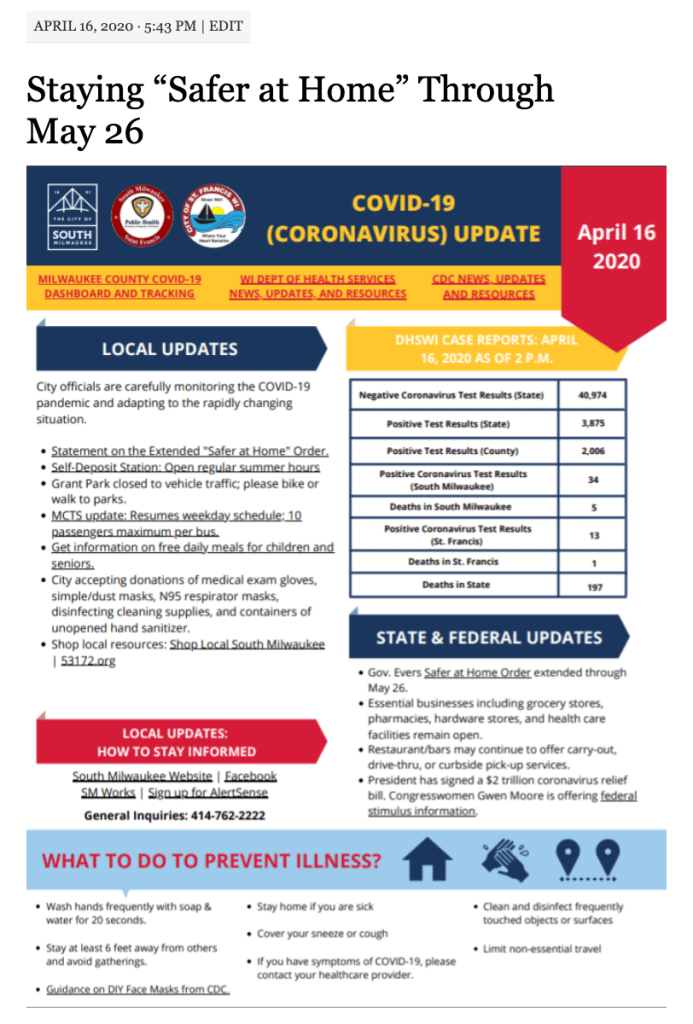
What I Learned: Communicating During the Pandemic
My crisis communications partner — former South Milwaukee Fire Chief Joseph Knitter — and I stand ready to help you plan for your worst day. Start with the basics. Then let’s explore things like audiences, scenarios, roles and responsibilities, action plans, messaging, templates, and more, together. Let’s also get your key people media trained. Now is the time to do this work, so you can be at your best when you most need to be.
The pandemic reminded us just how critical this is. Here are some lessons I learned:
- Accuracy, above all else. Do not sacrifice accuracy for speed, ever. Lives may depend on it. Get it right, not first.
- Be transparent. Be open and honest in your communications. Let data drive your decision making – and share that information with the public when and where you can. Let them know why you are doing what you are doing.
- Listen to the experts. Let them guide your messaging — and be the face on the camera when the situation calls for it.
- Strive for clarity. Use simple language to explain complex situations. Be clear. Get to the point. Share the facts, as you know them.
- But facts change. What was true early in a crisis may be different as new information is discovered and the situation evolves. Messaging might change hour to hour, day to day, week to week in a crisis, especially in a pandemic. It is OK to be wrong, especially during a fluid situation like a crisis. It happens. Just admit it and share the correct information.
- Messengers matter. Sometimes elected leaders should fill that role — have to fill that role. Sometimes it is department heads or staff. Sometimes partner agencies, organizations or governments need to step up. Identify roles as you plan for a crisis, and certainly before you step in front of the microphone or send the email.
- Choose the right platform – and sometimes it’s all of them. Not everyone is online, or even has access to high speed internet. So websites, social media, video, and emails only go so far. Consider other sources like landline and mobile phone messages, printed newsletters (like this special pandemic edition of Bridges magazine), billboards, sharing information through earned media … during the pandemic, we used all of these platforms and more to get the word out. Our goal: Share critical information with as many people as possible, meeting them where they are consuming that information.
- Find the positive — and celebrate it. Use your communications to lift up the people who are making a difference during the crisis. There was no shortage of this during the pandemic, and we regularly used our communications to spotlight the first responders, public health officials, nurses, and just normal, everyday people doing good.


 Brooks Communications + Community